CHEM.AI
LABORATORY

Publications

Recent research output, papers, and preprints from our group.

Thumbnail for j-IR-vis: Vision model for infrared spectroscopy embeddings

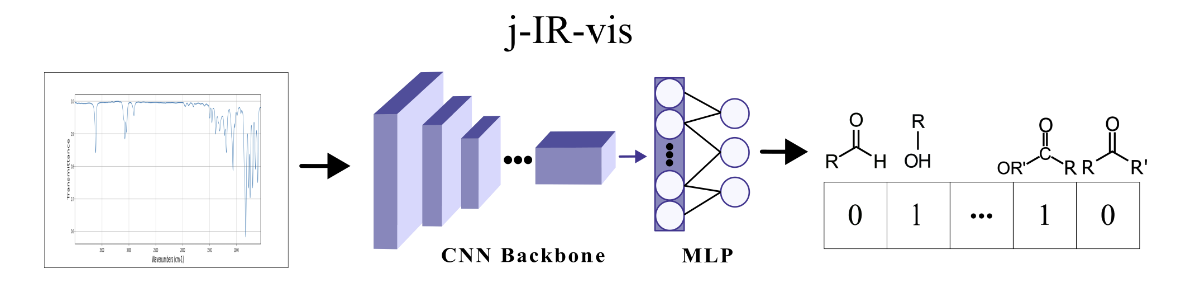
j-IR-vis: Vision model for infrared spectroscopy embeddings

Rudra Sondhi, Edwin Chacko, Rodrigo A. Vargas-Hernández (2026)

j-IR-vis is a vision-based neural network model designed to interpret infrared (IR) spectroscopy data. The model functions as a general-purpose spectral encoder that learns chemically interpretable representations directly from raw IR spectroscopy plots. Inspired by the ResNet family of vision models, it takes an IR spectrum image as input and performs multi-label classification of functional groups. Beyond classification, j-IR-vis embeds molecules into a spectroscopically informed similarity space, capturing relationships between molecules that are not always evident in standard fingerprint representations.

Thumbnail for ParetoMol: a free web application for multi-objective Pareto analysis of molecular properties

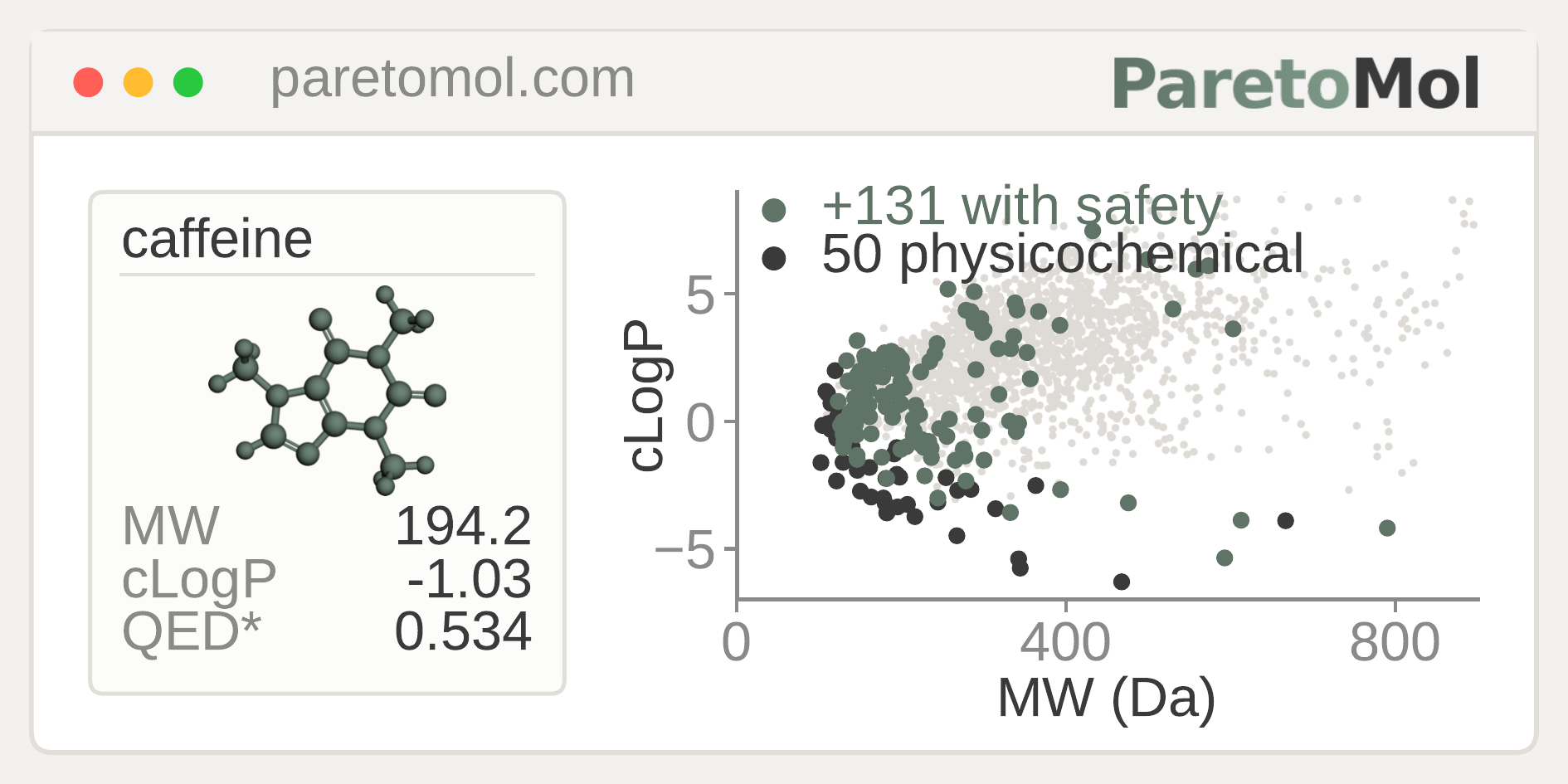
ParetoMol: a free web application for multi-objective Pareto analysis of molecular properties

Ilkham Yabbarov, Rodrigo A. Vargas-Hernández (2026)

ParetoMol is an open-source web application designed for the multi-objective Pareto analysis of molecular properties, specifically focusing on safety and pharmacokinetics. The tool helps researchers navigate the trade-offs involved in molecular optimization—such as balancing potency, selectivity, pharmacokinetics, and safety. ParetoMol accepts molecules via SMILES strings, CSV/SDF file uploads, ChEMBL target identifiers, or PubChem name resolution. It provides synchronized visualization tabs, including configurable Pareto scatter plots, BOILED-Egg partitioning, scaffold analysis, and chemical space projections.

Thumbnail for Bayesian Optimization for High-Dimensional Coarse-Grained Model Parameterization: A Case Study on Pebax Polymer

Bayesian Optimization for High-Dimensional Coarse-Grained Model Parameterization: A Case Study on Pebax Polymer

Carlos A. Martins Jr, Daniela A. Damasceno, Keat Yung Hue, Caetano Rodrigues Miranda, Erich A. Müller, and Rodrigo A. Vargas-Hernández (2026)

In this work, we present a Bayesian optimization framework for parameterizing high-dimensional coarse-grained (CG) force field models, challenging the conventional assumption that such approaches are limited to low-dimensional problems. Using the tree-structured Parzen estimator (TPE), we successfully optimize a 41-parameter CG model of Pebax-1657, a polyamide-polyether copolymer, simultaneously targeting structural and thermodynamic properties including density, radius of gyration, and glass transition temperature. Our approach not only converges faster than traditional search algorithms but also delivers consistent improvements over standard parametrization strategies, opening the door to scalable Bayesian optimization of complex molecular simulations.

Thumbnail for LivePyxel: accelerating image annotations with a Python-integrated webcam live streaming

LivePyxel: accelerating image annotations with a Python-integrated webcam live streaming

Uriel Garcilazo-Cruz, Joseph O. Okeme, Rodrigo A. Vargas-Hernández (2026)

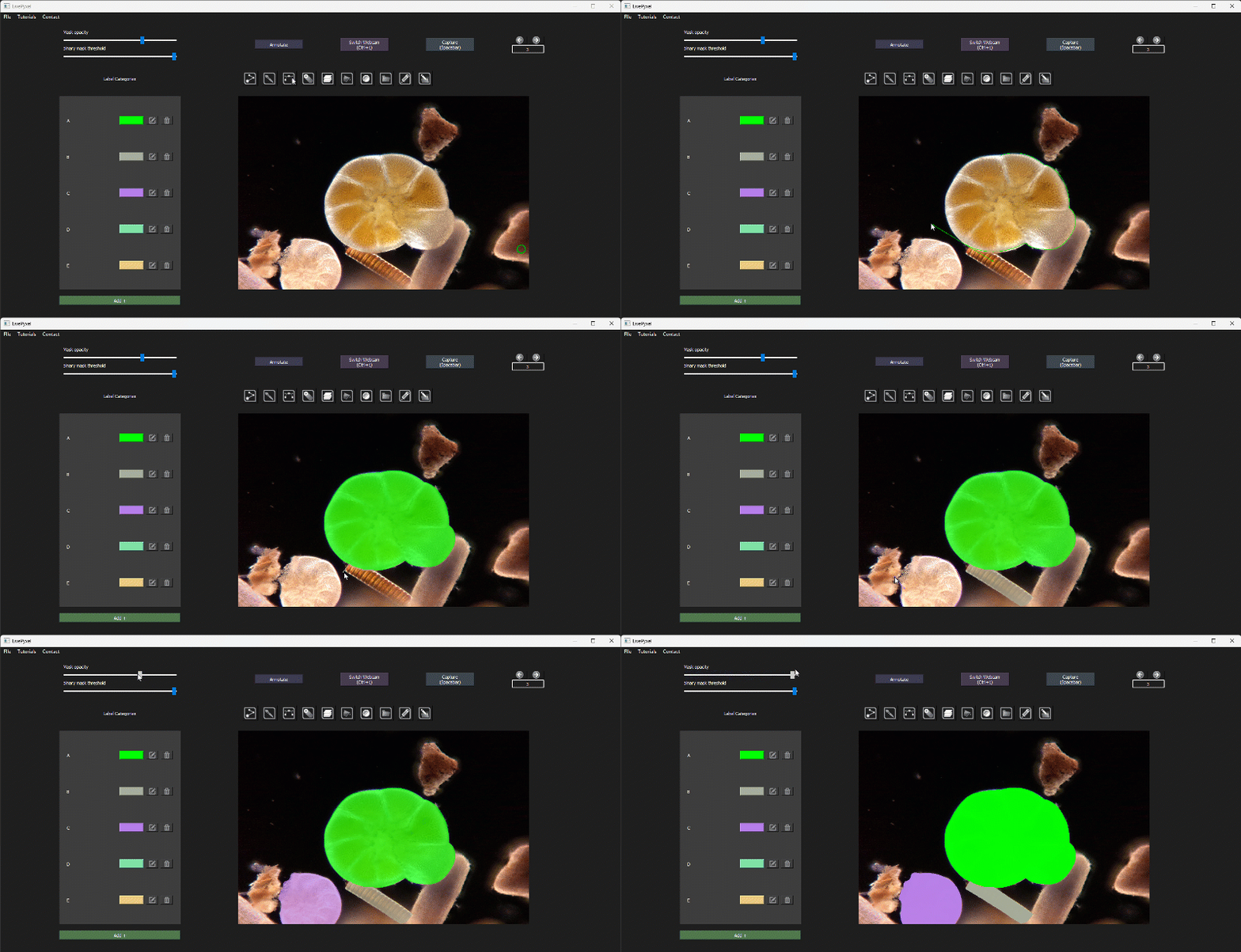
In this work, we introduce LivePixel, a Python-based graphical user interface that integrates with imaging systems—such as webcams and microscopes—to enable on-site image annotation in laboratory environments. LivePyxel addresses the limitations of existing annotation tools by supporting on-demand pipelines without requiring pre-collected datasets. The software features an intuitive interface with precision annotation tools, including Bézier splines and binary masks, alongside non-destructive layer editing for high-performance workflows. Built on OpenCV and NumPy, LivePyxel offers broad video device compatibility and is optimized for object detection tasks, accelerating the development of AI models in experimental settings.

Thumbnail for MOLPIPx: An end-to-end differentiable package for permutationally invariant polynomials in Python and Rust

MOLPIPx: An end-to-end differentiable package for permutationally invariant polynomials in Python and Rust

Manuel S. Drehwald, Asma Jamali, Rodrigo A. Vargas-Hernández (2025)

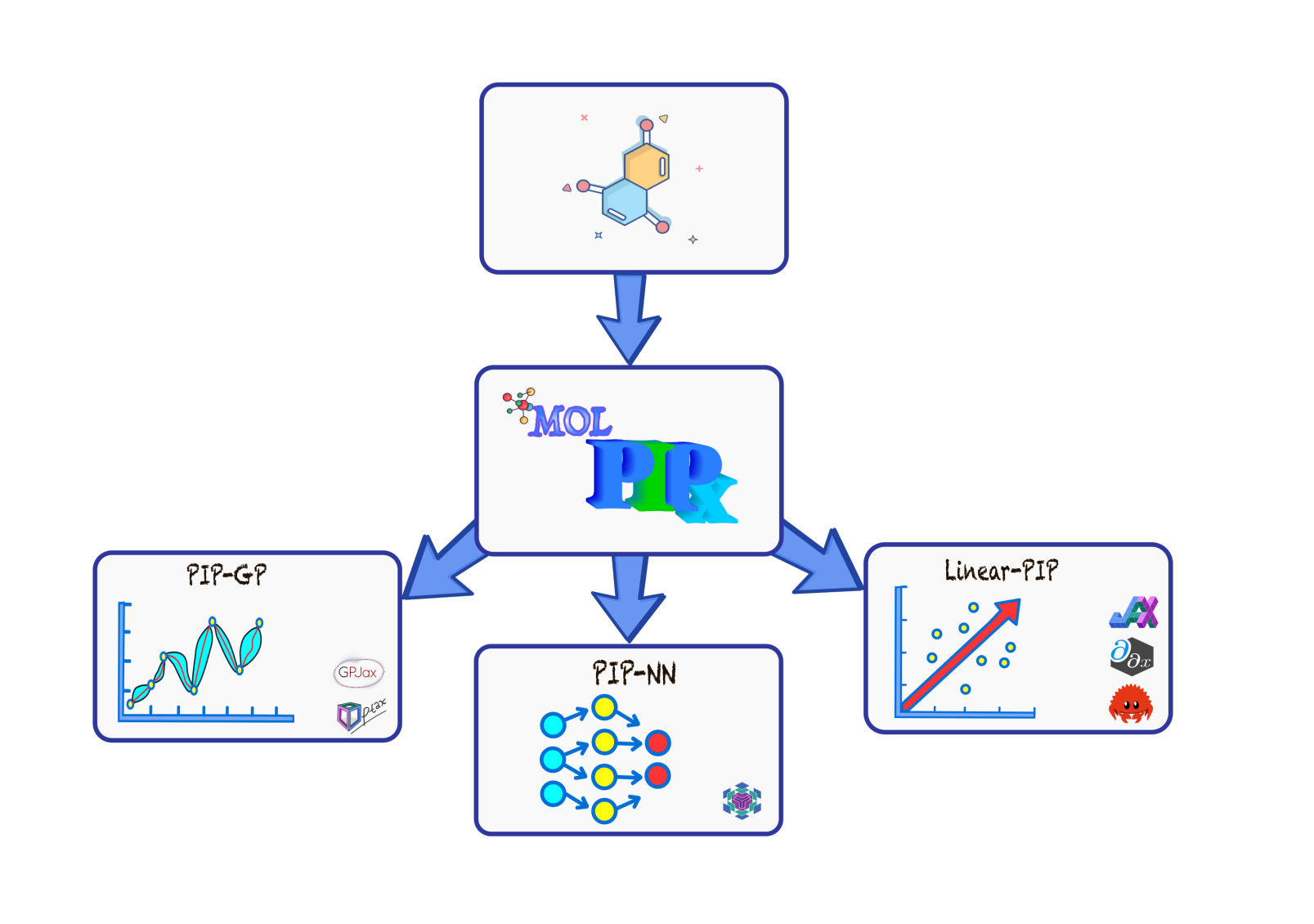
In this work, we present MOLPIPx, a versatile library designed to seamlessly integrate permutationally invariant polynomials with modern machine learning frameworks, enabling the efficient development of linear models, neural networks, and Gaussian process models. These methodologies are widely employed for parameterizing potential energy surfaces across diverse molecular systems. MOLPIPx leverages two powerful automatic differentiation engines—JAX and EnzymeAD-Rust—to facilitate the efficient computation of energy gradients and higher-order derivatives, which are essential for tasks such as force field development and dynamic simulations.

Thumbnail for Normalizing flows and orbital-free DFT

Normalizing flows and orbital-free DFT

A. de Camargo et al. (2024)

Orbital-free density functional theory (OF-DFT) for real-space systems has historically depended on Lagrange optimization techniques, primarily due to the inability of previously proposed electron density ansatze to ensure the normalization constraint. This study illustrates how leveraging contemporary generative models, notably normalizing flows (NFs), can surmount this challenge. We pioneer a Lagrangian-free optimization framework by employing these machine learning models as ansatze for the electron density. This novel approach also integrates cutting-edge variational inference techniques and equivariant deep learning models, offering an innovative alternative to the OF-DFT problem.

Thumbnail for Softmax parameterization of the occupation numbers for natural orbital functionals

Softmax parameterization of the occupation numbers for natural orbital functionals

L. Franco et al. (2024)

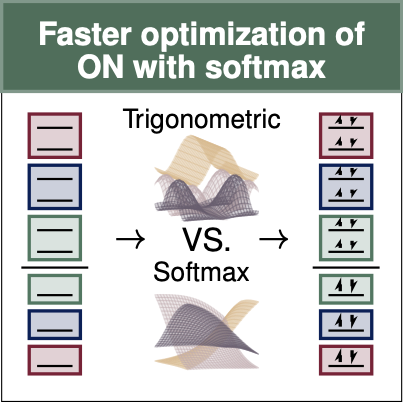
Within the framework of natural orbital functional theory, having a convenient representation of the optimization function becomes critical for the computational performance of the calculation. Recognizing this, we propose an innovative parametrization of the occupation numbers that takes advantage of the electron-pairing approach used in Piris natural orbital functionals, through the adoption of the softmax function, a pivotal component in modern deep-learning models. Our approach not only ensures adherence to the N-representability of the first-order reduced density matrix (1RDM) but also significantly enhances the computational efficiency of 1RDM functional theory calculations. The effectiveness of this alternative parameterization approach was assessed using the W4-17-MR molecular set, which demonstrated faster and robust convergence compared to previous implementations.

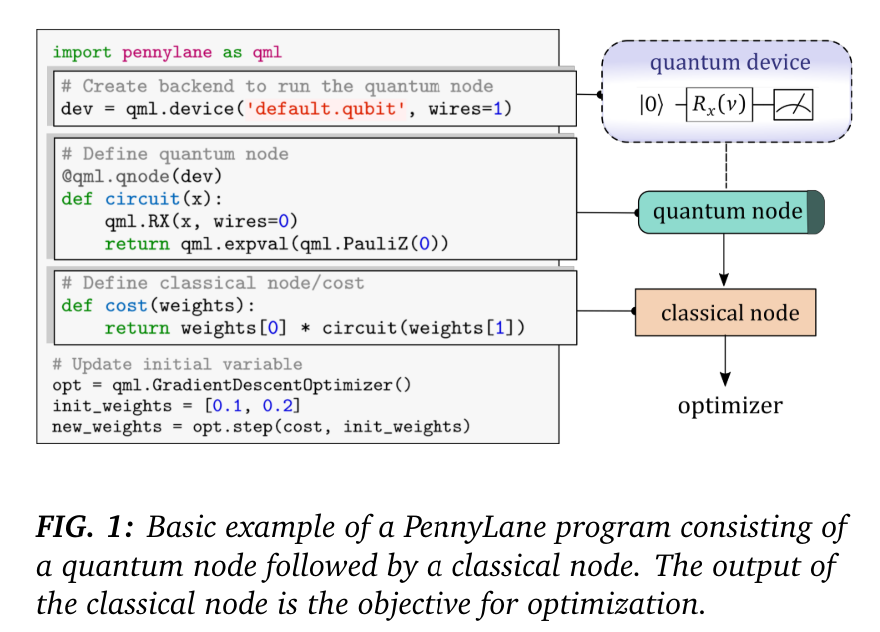
Thumbnail for PennyLane: Automatic differentiation of hybrid quantumclassical computations

PennyLane: Automatic differentiation of hybrid quantumclassical computations

V. Bergholm et al. (2022)

Lorem ipsum dolor sit amet consectetur adipisicing elit. Error culpa modi hic nihil accusamus? Accusantium dolore dignissimos dolorum ratione nihil deserunt unde maxime nisi eos, veniam vel, molestiae cum accusamus? Ducimus quibusdam repellendus ea reiciendis assumenda pariatur dolores sit voluptatum quasi. Unde facilis excepturi, voluptatem hic iste optio eius est fugit accusamus ratione nihil fugiat, tempora architecto, soluta magnam laborum.